


 Decking Screws
 Drilling Screws


Drywall Screws for Ceiling Installation: Size, Thread and Coating Selection
Choose drywall screws for ceiling work by three rules. Pick a screw length that drives at least 5/8 inch into wood framing or fully through metal studs. Match coarse thread to wood and fine thread to steel. Select the coating for the space: phosphate for dry rooms, zinc or stainless steel for damp ones. Overhead pull-out loads make weak choices show up fast as sagging and pops. This complete guide to types, sizes, and installation takes drywall screw length, thread, and coating one at a time.
Key Takeaways
- Choose a screw length that goes at least 1/2 inch into wood or fully through metal studs.
- Match coarse thread to wood framing and fine thread to metal studs for a strong hold.
- Pick a coating that fits the room's moisture: phosphate for dry areas, zinc for damp, stainless for wet.
Sizing Drywall Screws for Ceiling Installation
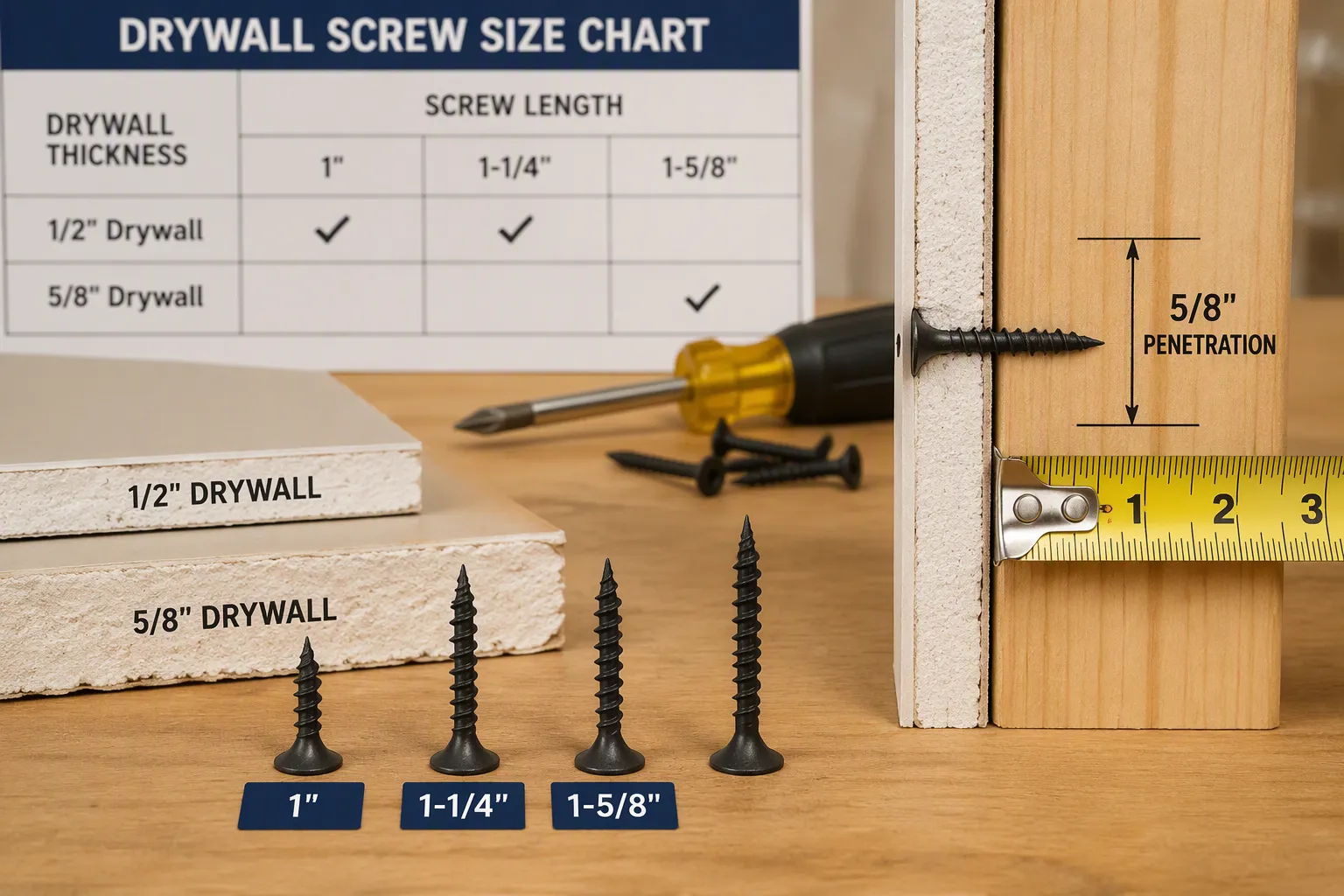
Length, Gauge and the Drywall Screw Size Chart
Screw length follows panel thickness. A 1¼-inch drywall screw is the most common choice for 1/2-inch panels. Step up to 1-3/8-inch or 1-5/8-inch lengths for 5/8-inch drywall sheet thickness. Layered assemblies need longer fasteners, because each added layer consumes screw length before the tip reaches framing. Choosing drywall screws for ceiling work starts with this thickness match.
Gauge describes screw length and diameter together. A #6 gauge has a thinner shank and suits standard 1¼-inch drywall screws. A #8 gauge carries a fatter shank that grips better in older wood, yet many installers find it harder to drive and harder on clutches. A thicker shank raises holding power in dense or aged lumber. Reserve #8 for longer screws where extra strength matters. Both gauges serve specific jobs, so match the gauge to the framing condition.
| Drywall thickness | Framing | Recommended length |
|---|---|---|
| 1/2 inch | Wood | 1¼ inch |
| 5/8 inch | Wood | 1-5/8 inch |
| 1/2 inch | Metal | 1 inch fine thread |
| 5/8 inch | Metal | 1-1/8 inch fine thread |
This drywall screw size chart covers common screw sizes and assemblies. Use it as a starting point, then confirm against the panel manufacturer's guidance. Published size charts vary slightly between makers, so read the label before buying. The table lists common lengths for each panel. Match the fastener to the panel and the framing before ordering in bulk.
Penetration Depth and Screw Spacing Requirements
Penetration matters more than overall fastener length. GA-216 sets the baseline for attaching gypsum drywall to wood:
"Fasteners shall be of sufficient length to penetrate wood framing members not less than 5/8 inch (16 mm) for screws." — GA-216, Application and Finishing of Gypsum Panel Products, Section 4.6.1
A 5/8-inch bite into wood is the code baseline, and 5/8 inch is the safer target. A drywall screw driven into metal studs must pass fully through the steel. Check the point style and thread against the framing before drywall installation begins.
Screw spacing requirements for ceilings are tighter than for walls, because every fastener resists gravity continuously. Place drywall screws every 6 to 8 inches along joints and every 12 inches across the panel field. Keep fasteners about 3/8 inch from panel edges. Wider field spacing lets panels sag between joists; overly tight spacing damages the board.
Joist spacing shapes the plan. At 16-inch centers, 12-inch ceiling spacing works with 1/2-inch board. At 24-inch centers, 5/8-inch Type X panels are preferred, and adhesive is strongly recommended. Consistent spacing spreads the load across more fastening points and limits the creep that produces pops and sag lines. Adhesive alone will not replace fasteners, so keep both in the assembly.
Coarse vs. Fine Thread for Ceiling Framing
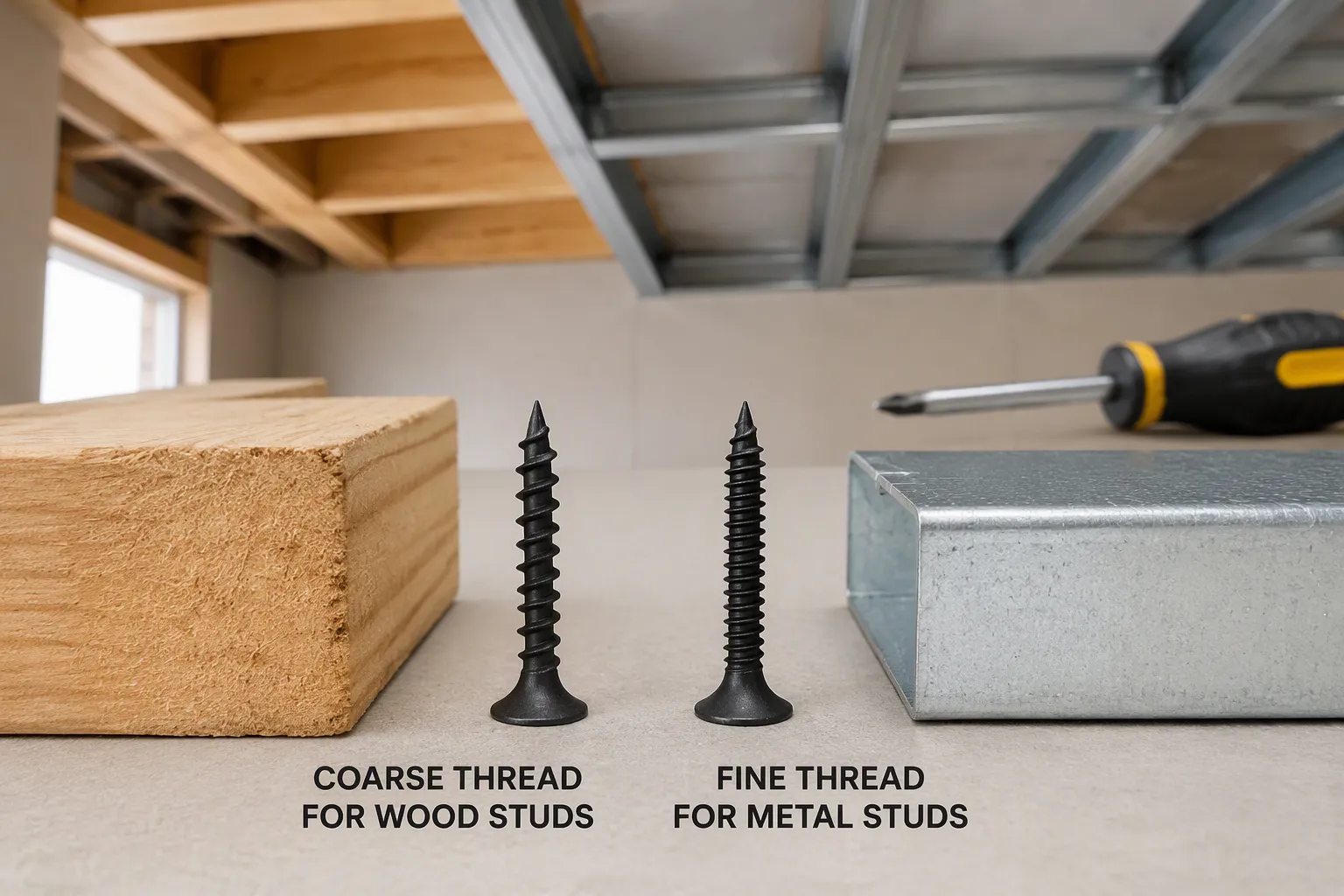
Matching Thread to Wood and Metal Studs
The coarse vs. fine thread decision follows the framing material. Coarse thread suits wood framing. Its wide, deep threads bite into wood fibers and create a strong mechanical bond. Fine thread suits light-gauge steel studs. Tight thread spacing engages thin metal without stripping the hole. Each thread type fits its own substrate, so match the fastener to the framing before ordering.
| Framing Material | Recommended Thread Type | Why It Works |
|---|---|---|
| Wood studs | Coarse-thread screws | Wider thread pitch grips fibrous wood; drives quickly and holds strongly |
| Metal studs | Fine-thread screws | Closer spacing creates more engagement points in thin steel without stripping |
A mismatch weakens the joint. Fine thread screws slip on soft wood fibers and strip out easily. Coarse-thread screws give insufficient engagement in light metal and can strip the stud. For metal framing, #6 gauge 1-¼ inch fine thread drywall screw sizes are recommended for better thread engagement and a secure hold. Fine thread screws are also made from high-carbon steel with a phosphate coating, which supports durability on steel substrates.
Specialty Threads and Withdrawal Resistance
Withdrawal resistance describes how strongly a drywall screw resists pulling out of the framing. Overhead ceilings load every fastener against gravity, so this property matters. According to NCMA tests, coarse thread drywall screws hold better against pulling forces in wood studs than fine thread screws, showing roughly a 20% improvement in withdrawal resistance. That gain confirms coarse thread as the stronger pull-out option in wood.
Hi-low thread screws offer an all-purpose path. Alternating high and low threads reduce driving torque and resist loosening under vibration, which suits mixed or uncertain framing. Point style matters too. Sharp piercing points bite into wood and pierce thin sheet metal near 25–22 gauge. Self-drilling points cut their own pilot hole in heavier steel, around 20 gauge or thicker. Using a self-drilling screw on very thin gauge metal can drill an oversized hole. On any gauge, over-spinning can damage the metal or break the screw. Specify framing type when sourcing drywall screws for ceiling work, and confirm the thread type against wood or metal studs before purchase.
Drywall Screw Coating Options
Phosphate, Zinc and Stainless Steel
Black phosphate drywall screws carry a thin conversion coating that offers light corrosion resistance. They suit dry interior ceilings over wood studding, where moisture stays low. Installers also value their porous surface, which bonds well with joint compound and paint. The phosphate layer protects through a barrier effect, and standard versions withstand roughly 24 to 50 hours of salt spray testing under ASTM B117.
Zinc-plated screws protect steel through sacrificial action. The zinc layer corrodes before the underlying steel does, which extends service life in mildly moist conditions. Standard zinc plating reaches about 48 to 50 hours of salt spray resistance, and yellow zinc versions approach 100 hours. Stainless steel sits at the top of the corrosion scale. Grades 304 and 305 resist rust in standard outdoor exposure, and grade 316 adds molybdenum for coastal and saltwater settings. Stainless fasteners commonly last 50 years or more, while zinc-plated screws in continuous exterior moisture last roughly 5 to 12 years.
Matching Coating to Dry, Damp and Humid Ceilings
Ceiling environment drives the coating decision. Dry, climate-controlled interiors call for black phosphate, the economical standard for drywall on wood framing. Damp indoor ceilings, such as bathrooms, kitchens, basements, and laundry rooms, call for zinc plating with a vapor barrier above. Humid, coastal, or semi-exposed ceilings warrant stainless steel, especially in beach house bathrooms where salt air accelerates corrosion.
Corrosion exposure is the deciding factor. Zinc plating cannot endure outdoor weather or pressure-treated lumber chemicals, so reserve it for indoor assemblies. Stainless steel handles exterior and high-moisture ceilings with minimal maintenance. Each coating fits its own environment, so match the finish to the moisture level before ordering drywall screws for ceiling work.
Best Practices for Ceiling Drywall Screw Installation
Driver Settings and Avoiding Overdriving
Driver clutch settings control how deep each drywall screw sinks. No single torque number transfers across tools, so start low and fine-tune on scrap material. For drywall, a clutch setting in the 1–5 range prevents overdriving and paper damage. A narrower 1–3 setting works well for most ceiling work.
Drive screws just deep enough that the head sits slightly below the drywall surface without breaking the paper. An auto-feed screw gun with a depth-sensitive clutch releases the screw at a pre-defined depth.
Test the drywall screw depth on scrap made from the actual panel and framing. A setting that works on 1/2-inch board over wood may overdrive on a softer panel or strip light-gauge steel. A depth-sensitive clutch helps hold the correct depth.
Pre-Installation Checklist
Confirm the assembly before buying any drywall screw. Panel thickness, framing type, layers, point style, screw length, and corrosion exposure each shape the order. A wood screw may not match drywall installation, and a coarse thread may fail to engage steel. Each drywall screw must reach the framing.
Work through these steps before purchase:
- Confirm the exact panel product and thickness.
- Count every layer the drywall screw must pass through.
- Identify wood, light-gauge steel, or heavier steel framing.
- Determine the required framing penetration from current panel instructions.
Ceiling panels benefit from 5/8-inch drywall and drywall screws at least 1-5/8 inches long, which gives about 1 inch of penetration into wood. Construction adhesive along the joists adds security. Choose fine thread for steel framing and a coarse-thread screw for wood. These lengths and thread choices support a stable ceiling.
Three checks settle the choice of drywall screws for ceiling work:
- Lengths that bury at least 5/8 inch in wood or pass fully through metal.
- Thread matched to wood or steel framing.
- Coating matched to the ceiling's moisture.
Confirm panel thickness and framing first. Then hold steady spacing and driver settings. That pairing keeps drywall flat overhead, free of pops, and protected from corrosion.
FAQ
What length drywall screw works for a ceiling with 5/8-inch panels?
Use a 1-5/8-inch drywall screw for 5/8-inch panels over wood framing. This length leaves enough shank to reach the joist and still bury at least 5/8 inch into the wood.
Can I use the same screw for wood and metal ceiling framing?
No. Coarse thread grips wood fibers, while fine thread engages thin steel without stripping. Match the thread to the framing material before purchase, and confirm the point style suits the stud gauge.
How often should I space drywall screws on a ceiling?
Place drywall screws every 6 to 8 inches along joints and every 12 inches across the panel field. Keep each screw about 3/8 inch from panel edges to avoid crushing the board.