


 Decking Screws
 Drilling Screws


How to Source Screws from China: A Practical Guide for Importers
Sourcing screws from China works best with a repeatable workflow. Importers must handle specification, supplier verification, sampling, compliance, payment protection, quality control, and logistics in sequence. This guide shows how to avoid substandard products, supplier scams, and shipping surprises. A reliable screw manufacturer China partner starts with clear specifications and verified credentials.
Key Takeaways
- Importers must define complete screw specifications first. Size, material, coating, and packaging matter. This step prevents costly errors.
- Verify each supplier's credentials and request pre-production samples. Check business scope, factory equipment, and staff. Samples reveal real quality.
- Use a 30% deposit. Pay the remaining 70% after inspection passes. Choose FOB shipping terms to compare true landed costs.
Why Importers Choose Chinese Screw Manufacturers
Chinese screw factories give importers a clear cost advantage. Piece prices are low, production capacity is broad, and OEM/ODM support is common. Many factories offer flexible packaging, private labeling, and custom head or thread design. These capabilities make a screw manufacturer China partner valuable for distributors, hardware brands, and construction suppliers.
Cost and High-Volume Production Advantages
Importers routinely source chipboard screws, drywall screws, wood screws, self-drilling screws, and concrete screws from these plants. High-volume production keeps unit prices down. One medium-sized factory can turn out 5,000 to 6,000 tons of fasteners per year, which supports continuous manufacturing and steady monthly shipments.
That scale also lowers costs through longer production runs. The table below shows the annual capacity typical of a mid-sized screw manufacturer in China:
| Manufacturer Type | Production Capacity (tons/year) |
|---|---|
| Medium-sized Manufacturer | 5,000 |
| Medium-sized Manufacturer | 6,000 |
Matching Sourcing Strategy to Lead Time and Volume
Importing works best for high-volume, forecastable orders. If your lead time is 90 days or more, there is room for production, inspection, and sea freight. Urgent or small orders may be better sourced domestically, even when Chinese piece prices are lower.
Lead times vary by order and supplier. Standard-size stainless steel SEM screws take 10–15 working days at one manufacturer; custom specifications take 20–30 working days. Another guide reports catalog fasteners ship in two to four weeks. Custom-machined fasteners require 5–15 days plus transit. The table below shows common ranges:
| Manufacturer | Best For | Lead Time |
|---|---|---|
| XTJ CNC | CNC-machined custom fasteners | 5–15 days |
| Hisener Industrial | Standard & specialty screws at volume | 3–4 weeks |
| DT Fastener | High-strength structural fasteners | 4–6 weeks |
Define Screw Specifications Before You Contact a Supplier
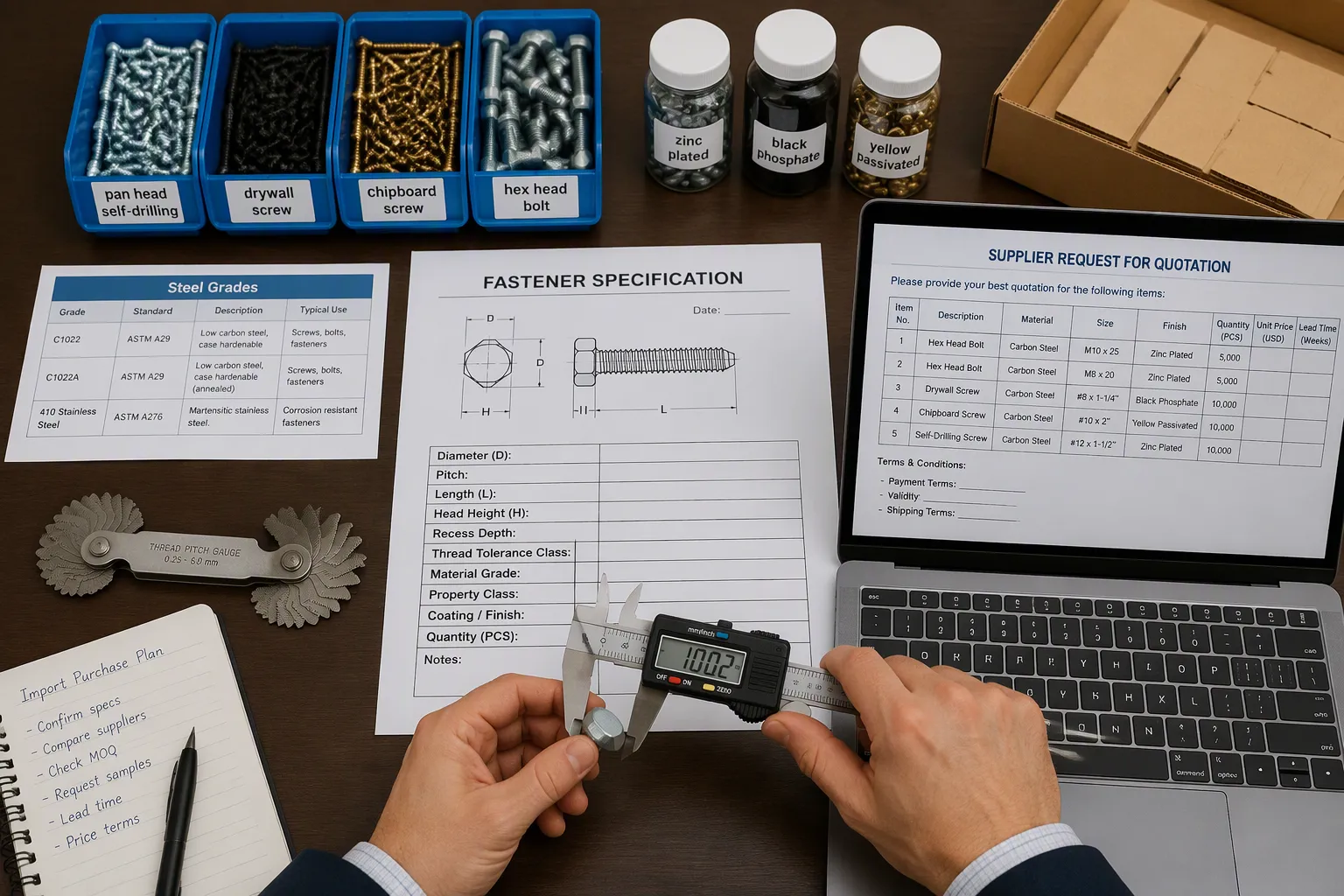
A complete specification sheet prevents costly errors. It gives every screw manufacturer China partner the same target. Importers should prepare this document before requesting quotes.
Document Size, Material, Grade, and Quantity
Start with the screw type, diameter, pitch, and length. State head height, recess depth, and thread tolerance class. Include usable thread length and all dimensional tolerances. Material grade matters just as much. Specify carbon or alloy steel grades, or stainless grades such as 304 and 316 (A2/A4). Cite the relevant product standard, for example ISO 4762, ISO 898-1, or ISO 3506-1.
Mechanical properties belong on the sheet too. State the property class, such as 8.8, 10.9, or 12.9 for steel, or A2-70 and A4-70 for stainless. List required checks for tensile strength, hardness, and torque performance. Target quantity and application complete this first block of data.
Common steel grades vary by product. The table below shows typical matches:
| Steel Grade | Application |
|---|---|
| C1022 with heat treatment | Black phosphate drywall self-drilling screw |
| C1022A | Black phosphate drywall screw |
Grade 410 stainless steel suits pan head self-drilling screws. It resists hot gases, steam, mild acids, fresh water, and dry air.
Specify Drive, Thread, Coating, and Packaging
Drive type, thread configuration, and point type must be explicit. Name the head style and drive recess. Surface treatment needs the same precision. Specify the coating system, such as zinc plating, zinc flake, black oxide, or passivation. State coating thickness where relevant. High-strength fasteners require attention to hydrogen-embrittlement risk.
Real examples show the level of detail needed. A zinc yellow passivated Pozi chipboard screw with wax coating drives smoothly into particleboard. A black phosphate drywall screw suits wooden studding. A galvanized hex head self-drilling screw and a hex washer head concrete screw each serve distinct applications.
Manufacturing process affects cost and performance. Material forming, thread rolling, heat treatment, and coating all change the final part. Name these steps when ordering custom screws.
Packaging requirements deserve equal attention. Factories offer bulk cartons, small bags, blister packs, plastic boxes, buckets, and private-label packaging with barcode labels. Request batch and lot traceability with clear labels.
Packaging integrity is checked before shipment, and damaged outer cartons are replaced with new cartons.
Request material certificates, dimensional reports, hardness and tensile test results, coating-thickness verification, and first-article inspection. Agree on a sampling plan upfront.
How to Vet a Screw Manufacturer in China
Vetting a screw manufacturer China requires more than a website check. A systematic review covers legal registration, production equipment, sampling, payment, and shipping. These steps separate reliable plants from red flags.
Verify Factory Credentials and Request Samples
Check the unified social credit code first. The first digit must be 9. Entity type "1" means a legal entity. Business scope should list production verbs like production, manufacturing, processing. See the table below.
| Indicator | Reliable manufacturer | Trading company red flag |
|---|---|---|
| Business scope | production, manufacturing, processing | wholesale, retail, sales |
| USCC first digit | 9 (SAMR) | Non-9 code |
| Floor area | 2,500+ m² production | 50–200 m² office |
A qualified plant runs cold forging machines, heat treatment furnaces, coating lines, and automated thread rollers. It owns tensile and hardness testers. Production workers should make up 70-85% of staff. QA and engineering roles must exist on-site. A plant without these markers cannot hold tolerances.
Request samples before bulk orders. A pre-production sample from a pilot run reveals real quality. Measure thread pitch, drive fit, and coating thickness. Run the screw in your target material. Confirm the coating passes your salt-spray test. Samples cost little compared with a rejected container. Always request samples under the same process planned for mass production.
Protect Payment, Inspect Quality, and Plan Shipping
Payment terms protect the importer. A common structure is 30% deposit and 70% after inspection passes. Never send the full balance before shipment. If a supplier demands full payment upfront, walk away. Tie final payment to an inspection report.
Third-party inspection follows the ANSI/ASQ Z1.4 standard. General Inspection Level II is the default. Set AQL 2.5 for majors and 4.0 for minors. A lot of 3,201–10,000 screws requires a sample of 200 pieces. Accept 10 or fewer majors; reject at 11. Minor defects accept 14, reject 15. Use tightened sampling for first orders. Use reduced sampling only after clean lots.
The chart shows how sample size grows with lot size.
Choose Incoterms before shipping. FOB gives the buyer control and avoids supplier markups of 20-30%. CIF looks simpler but still leaves the buyer paying clearance, duties, and inland delivery. CIF quotes may hide a freight markup.
Compare landed costs, not quotes. An FOB order of USD 10,000 needs added sea freight and insurance about USD 1,200, import duty at 5% (USD 500), clearance about USD 400, VAT around USD 1,400, and inland transport near USD 300. Total landed cost is roughly USD 13,800, about 38% above FOB. A lower FOB quote can cost more than a higher CIF quote.
Avoid common mistakes. Do not compare prices alone. Do not skip samples. Do not ignore coating requirements. Confirm packaging and lead time in writing. A screw manufacturer China partner that allows inspection is worth more than the lowest quote. A vetted screw manufacturer China supply chain protects your margin.
A reliable screw manufacturer China demands the full workflow. Define complete screw specifications first. Verify factory credentials, request samples, and hold final payment until a third-party inspection passes. Plan shipping with clear Incoterms.
Write your complete specification sheet today. Then contact two or three shortlisted suppliers for quotes and samples.
FAQ
What payment terms protect an importer?
Use a 30% deposit with the 70% balance released after inspection passes. Never pay the full amount before shipment. A supplier demanding full upfront payment is a red flag.
Which Incoterm works best for screw imports?
FOB gives the buyer control and avoids supplier freight markups. CIF looks simpler, yet the buyer still pays clearance, duties, and inland delivery. Compare landed costs, not quotes.
| Incoterm | Who Controls Freight | Hidden Cost Risk |
|---|---|---|
| - | - | - |
| FOB | Buyer | Low |
| CIF | Supplier | Freight markup |
How many samples should I inspect before a bulk order?
Request pre-production samples from a pilot run. Measure thread pitch, drive fit, and coating thickness. Run each screw in your target material. Confirm salt-spray performance before approving mass production.