


 Decking Screws
 Drilling Screws


Self-Drilling Screws for Steel Frame Construction: What Buyers Should Know
Self-drilling screws are fasteners with an integrated drill point. They drill, tap, and fasten in one step without a pilot hole. For steel framing, this means faster installation, fewer tools, and consistent connections.
Eliminating the pre-drilling step cuts installation time by up to 50%.
Buyers must choose the right self drilling screws for steel frame projects by matching screw type, drill point, and material to the job.
Key Takeaways
- Self-drilling screws save time by drilling, tapping, and fastening in one step. No pilot hole is needed.
- Match the drill point to steel thickness. Use TEK 4 or TEK 5 for 6mm steel. TEK 3 works only up to 4.5mm.
- Choose the right material and coating for the environment. Stainless steel 304 or 316 resists corrosion outdoors.
Self-Drilling vs. Self-Tapping Screws
The Drill Point Difference
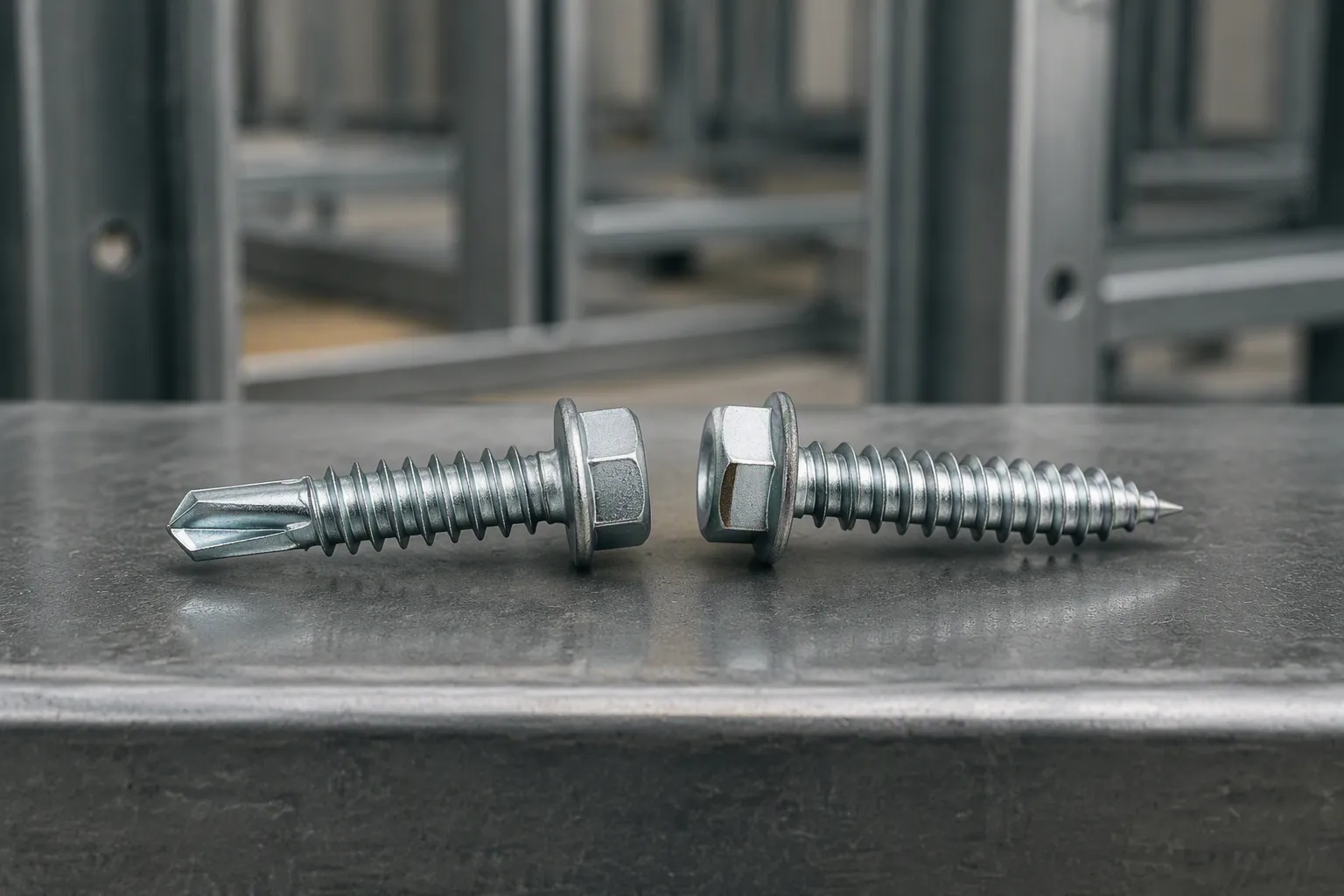
All self-drilling screws are self-tapping, but not all self-tapping screws are self-drilling. This distinction matters for buyers. A self-drilling screw features an integral drill point with cutting lips and flutes at the tip. When driven, this point cuts its own pilot hole, and the thread section immediately behind it forms threads in the freshly drilled hole. No pre-drilling is needed. In contrast, self-tapping screws have no drill point. They require a pre-drilled pilot hole and form threads by displacing material rather than cutting it.
The mechanical property standards reflect this difference. Self-drilling screws are governed by ISO 10666, while self-tapping screws fall under ISO 2702 or DIN ISO 7085. The drill point on a self-drilling screw demands a higher surface hardness — at least 530 HV0.3 — because it performs cutting operations. The thread section maintains the standard 450 HV0.3 requirement. This differential hardening comes from controlled heat treatment.
The self-drilling screw requires a higher surface hardness at the drill point (≥530 HV0.3 vs ≥450 HV0.3) because the drill point performs cutting operations.
When to Use Each Type
Self-tapping screws suit thin metals and materials where a pilot hole is practical. Self-drilling screws excel in steel frame construction, roofing, cladding, and solar mounting. They eliminate a separate drilling step and reduce tool changes on site.
Drill point selection depends on steel thickness. The TEK number system guides this choice:
| TEK Number | Maximum Steel Thickness (inches) |
|---|---|
| TEK 1 | 0.036 (up to 20 gauge) |
| TEK 2 | 0.075 (14 to 20 gauge) |
| TEK 3 | 0.140 (10 to 14 gauge) |
| TEK 4 | 0.250 (3/16 to 1/2 inch steel) |
| TEK 5 | 0.500 (up to 1/2 inch steel) |
For thick steel, a pilot hole is still needed even with self-tapping screws. The drill flute length must exceed the material thickness. If threads engage the metal before the drill point finishes cutting through, the fastener binds. The threads pull the screw forward faster than the point can remove metal. This causes the fastener to snap under torsional load or strips the newly cut threads, destroying holding power.
Choosing Self Drilling Screws for Steel Frame Applications
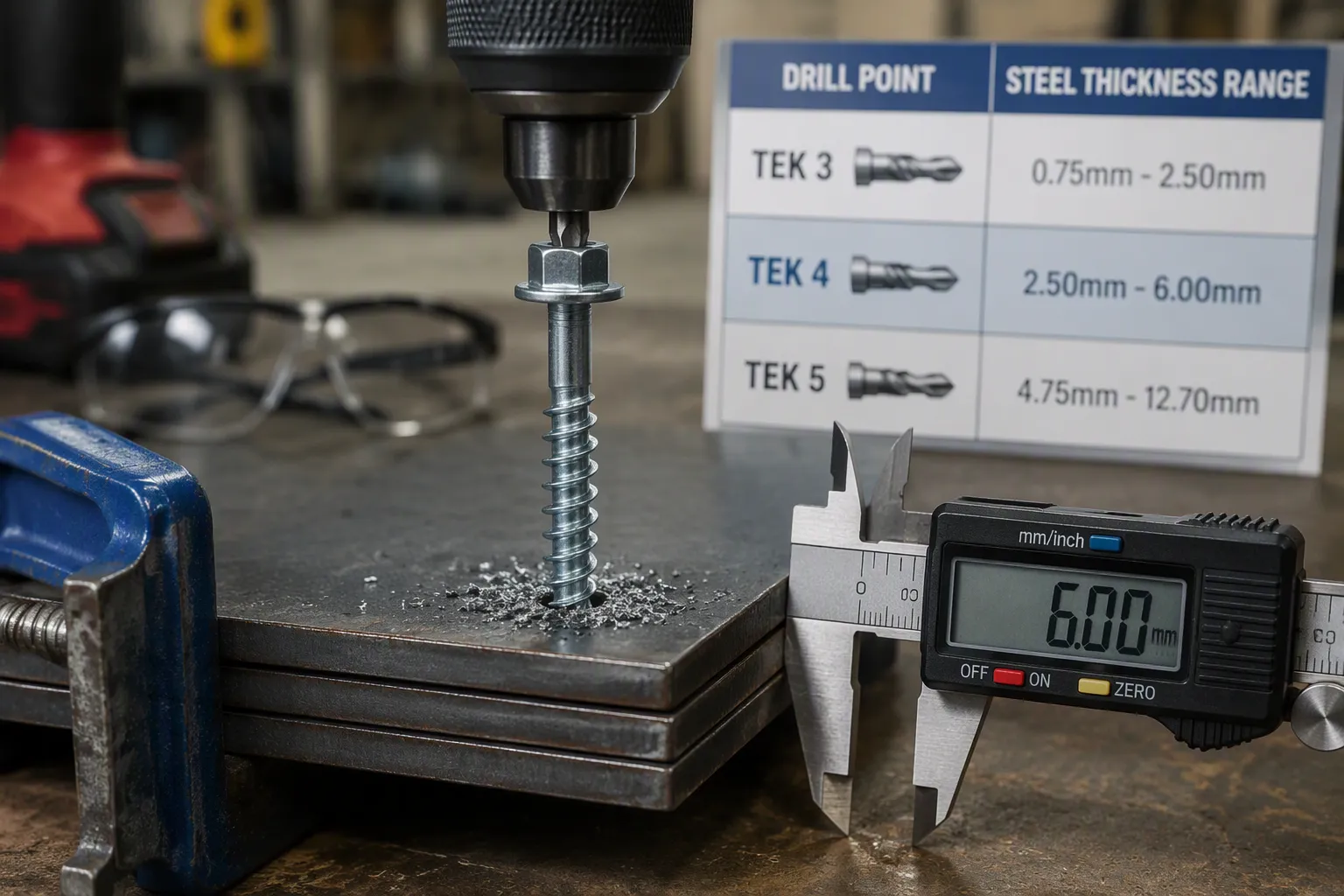
When selecting self drilling screws for steel frame projects, buyers must match the drill point to the steel thickness. The wrong drill point leads to broken screws, stripped threads, or failed connections.
Matching Drill Points to Steel Thickness
Galvanized hex head self-drilling screws penetrate steel plates up to 6mm without pre-drilling. This capability makes them ideal for metal building construction.
ANSI/ASME B18.6.4 specifies installation torque, thread engagement, and screw performance for self-drilling screws.
| Drill Point (Tek) | Drilling Capacity (Steel Thickness) | Suitability for 6 mm Steel |
|---|---|---|
| Tek 3 | 2.0 mm – 4.5 mm | Not suitable — will burn out on 6 mm steel |
| Tek 4 | 3.0 mm – 6.0 mm | Suitable — covers 6 mm steel |
| Tek 5 | 4.5 mm – 12.7 mm | Suitable — covers 6 mm steel and thicker |
A Tek 3 point works only for steel up to 4.5mm. For 6mm steel, a Tek 4 or Tek 5 point is necessary. The Tek 5 point handles thick steel fixing, drilling through up to 12.7mm of steel.
Thick steel fixing | 12-24 x 32mm to 12-24 x 50mm | No.5 drill point | Drilling capacity and steel thickness
Metal-to-Metal and Metal-to-Wood Connections
Self-drilling screws work for both metal-to-metal and metal-to-wood connections. For a metal roof installation, self-drilling screws attach metal panels to steel purlins. The EPDM-sealed washer creates a watertight seal.
Buyer's Guide: Materials and Coatings
Corrosion Resistance and Compatibility
Material selection determines long-term performance. Stainless steel 304 or 316 suits corrosive outdoor environments. Galvanized carbon steel works for general construction.
EPDM-sealed integrated washers create watertight connections for roofing and cladding.
Standards and Mistakes to Avoid
| Standards Body | Specific Standard(s) | Properties Covered |
|---|---|---|
| DIN | DIN standards | Dimensions and material requirements |
| JIS | JIS standards | Dimensions, materials, and mechanical properties |
| ANSI | ANSI B18.6.4 | Size and shape requirements |
Buyers should confirm the connection type, match the drill point to steel thickness, and select a coating for the environment.
FAQ
Which drill point works for 6mm steel?
A Tek 4 or Tek 5 point handles 6mm steel. A Tek 3 point covers only up to 4.5mm and will burn out on thicker plate.
Which material suits outdoor steel frame projects?
Stainless steel 304 or 316 resists corrosive outdoor conditions. Galvanized carbon steel serves general construction.
Can self-tapping screws replace self-drilling screws on steel frames?
No. Self-tapping screws need a pre-drilled pilot hole. Self-drilling screws cut their own hole, which saves time and tool changes on site.